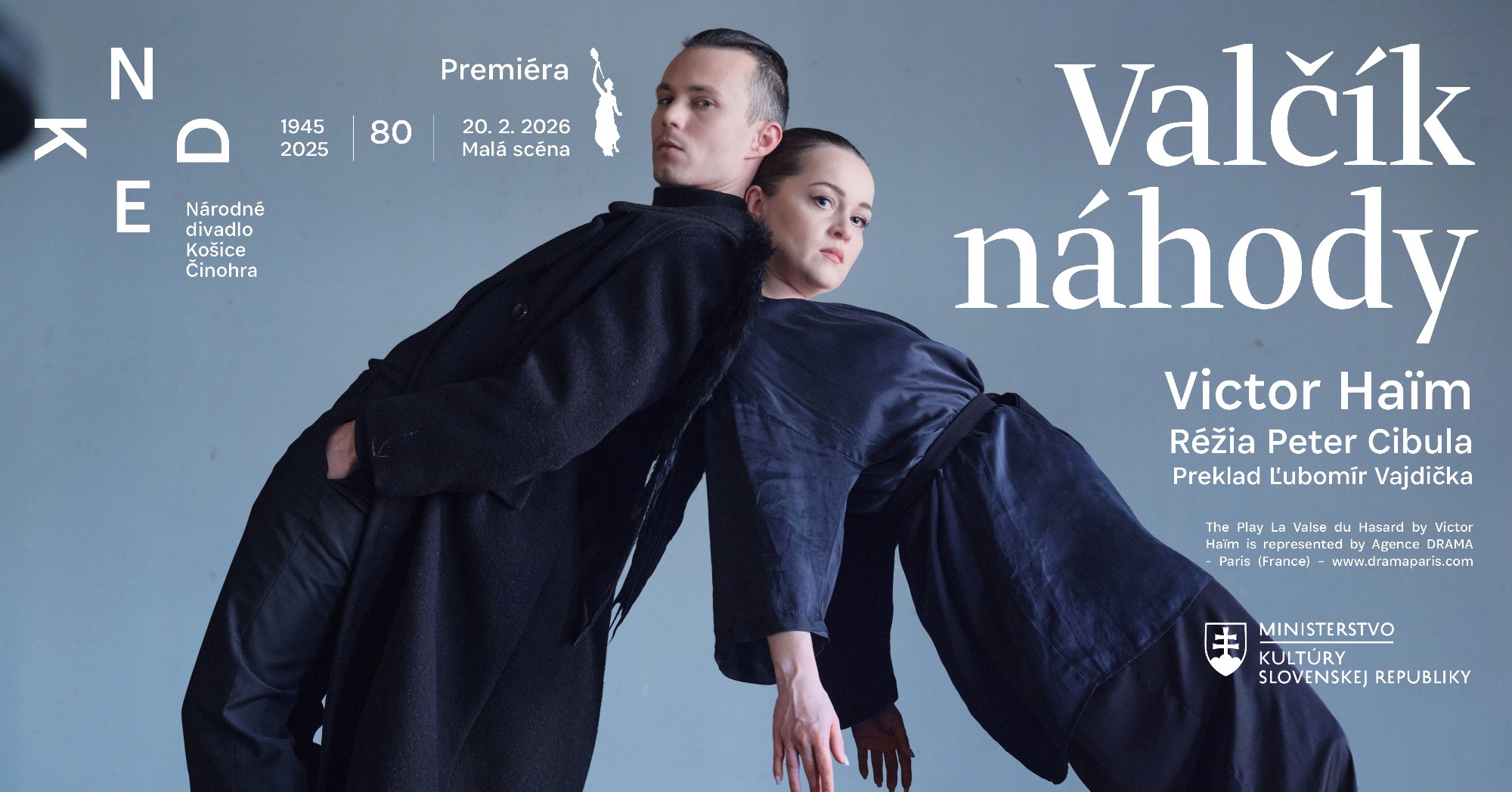
The chamber play about life after life by the acclaimed French author Victor Haïm, The Waltz of Chance, will premiere on Friday, 20 February, on the Small Stage as the Drama Company of the National Theatre Košice’s next premiere of the season. In the production directed by Peter Cibula, Lívia Michalčík Dujavová as the Woman and Tomáš Diro as the Angel whirl into a frantic waltz of questions and answers filled with irony.
Playwright, actor, screenwriter, journalist and teacher Victor Haïm is one of France’s most acclaimed dramatists. Among other honours, he received the Lifetime Achievement Award from the French Society of Dramatic Authors and Composers, and in 2003 was awarded the Molière Prize for Best Living Francophone Author.
The Waltz of Chance (La Valse du Hasard), written in 1986, is one of his best-known plays and earned him the Jacques Audiberti Prize. After her death, a Woman finds herself in a place we call purgatory and is compelled to play a game with an Angel. He acts as the judge in the game, listening closely to the story of her life. The rules appear simple: if she reaches one hundred points, the path to heaven is open to her. Yet nothing is as straightforward as it first seems. The beautiful woman must go to the very core, must be absolutely honest. Nor is it easy for the Angel’s either, as the game gradually brings them closer together and it becomes apparent that nothing human is alien to him.
For director and actor Peter Cibula, the genre of chamber drama is not unfamiliar, but this is his first encounter with Victor Haïm’s work.
“I do not know exactly what inspired him to write this play, but it is certainly fascinating already in the very choice of its setting — Purgatory. A place somewhere between heaven and earth, a kind of in-between space. The author offers us a record of what such a place might look like, while at the same time prompting us to reflect on whether the meaning and goal of our earthly existence is to reach heaven, or rather to live our lives as fully as possible. Doing good should not be conditioned by reward. I believe that sometimes our faith, or lack of it, can serve as a kind of alibi, an unwillingness or inability to care for others, or to change our attitudes and lives here and now. There are many more messages and questions in the play. With our production, we do not wish to impose answers on the audience. Each person must find their own answers, just as in life,” says director Peter Cibula.
The dramaturg of the new production is Peter Himič. The set and costumes were designed by brothers Jaroslav and Miroslav Daubrava, the original music was composed by Zuzana Eperješiová, and choreography was created in collaboration with Andrej Sukhanov.